September 18, 2026 · Trucko Team
Load Overlap Prevention: Why Sequential Load Enforcement Is the Missing Layer in Most Fleets
Load overlap quietly drains small fleets through pay disputes, fuel fraud, and unverifiable trips. Here's how sequential load enforcement closes the gap.
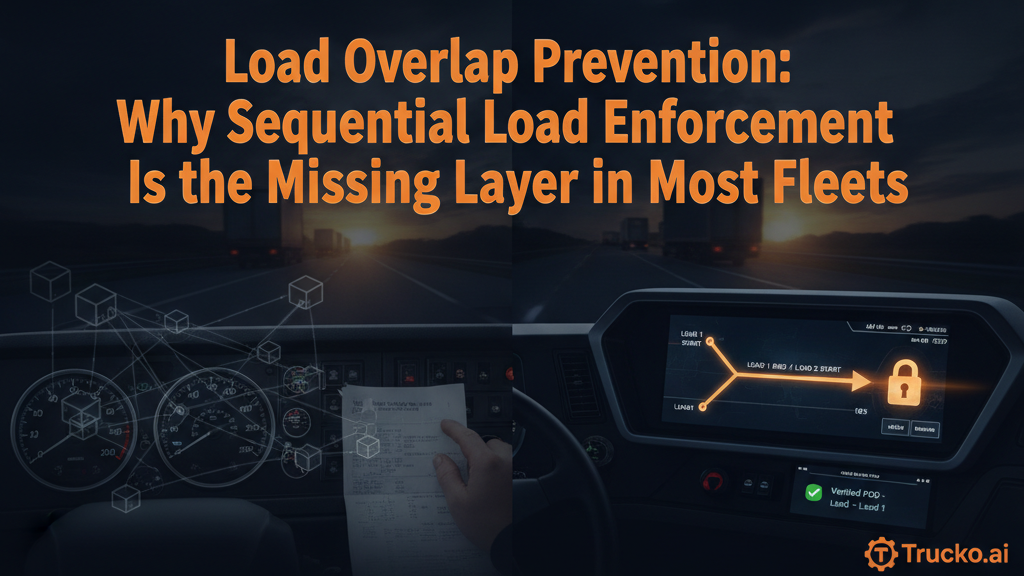
Load Overlap Prevention: Why Sequential Load Enforcement Is the Missing Layer in Most Fleets
Most fleet operators running 5 to 50 trucks have thought about mileage disputes and maybe fuel fraud. Fewer have thought about what happens between loads — the gap where a driver can be "on a run" in your dispatch sheet while also pulling unauthorized miles or stacking claims across overlapping assignments.
That gap has a name: load overlap. And closing it requires something most fleets don't have yet: sequential load enforcement.
This isn't a fringe problem. It's a structural one, and the fix isn't more trust. It's better gating.
What Load Overlap Actually Is
Load overlap happens when a driver is dispatched on a second load before the system has confirmed the first one is complete. In a trust-based or manual dispatch environment, that sounds like a minor coordination problem. In practice, it creates conditions for a specific kind of pay and mileage fraud that's almost impossible to catch after the fact.
Here's a simple version of how it plays out: a driver closes out Load A informally — a text, a call, a handshake — and gets assigned Load B. But Load A was never formally verified: no confirmed delivery, no end odometer reading, no signed POD uploaded. So the driver now has two open assignments in your records. If they submit mileage or pay claims for both, you have no clean data point to dispute either one.
A more deliberate version: a driver self-reports the close of Load A with inflated mileage, knowing that by the time Load B opens in your system, the overlap window is long gone and nobody's going back to check the odometer sequence.
Either way, the arithmetic gets messy — and it always resolves in the driver's favor.
How Overlap Happens Without Anyone Noticing
Overlap thrives on the same conditions most small fleets run on: phone-based coordination, verbal confirmations, and spreadsheets that track what was assigned but not what was actually verified.
A dispatcher reassigns a truck because the previous delivery was reported complete. That report came via text. The next run starts. The odometer at the start of Load B doesn't match the end of Load A — but nobody's checking that sequence in real time because nobody has a clean end reading for Load A to begin with.
This isn't operator negligence. It's a documentation architecture problem. When your system records assignments but doesn't gate them, you're always working from self-reported data. And as the Chrome River study (via Automotive Fleet) found, 76% of documented mileage fraud cases trace directly to manual submission processes. That's not a driver character problem. That's a process problem — and process problems have process solutions.
The other thing that makes overlap hard to catch: it doesn't look like fraud in the moment. It looks like fast drivers and a busy week. The signal only becomes visible when you pull odometer sequences side by side, and most fleets never do that because they don't have clean enough data to make the comparison meaningful.
Why Manual Dispatch Can't Close This
Some operators try to solve overlap through better dispatcher habits: more check-ins, more confirmation texts, tighter closeout calls. The intent is right, but the mechanism doesn't hold.
Manual confirmation still depends on the driver accurately reporting the state of a load. A driver who texts "all done" before the POD is actually captured has technically told you the load is closed. Your dispatcher records it as closed. But nothing in your system prevented the next assignment from opening before that load was actually verified.
The gap isn't between the dispatcher and the driver. It's between what someone said happened and what the system can actually confirm happened.
That's a gating problem, not a communication problem. More calls don't fix it. Gating does.
What a Verified Trip Actually Looks Like walks through exactly what confirmation looks like when it's data-backed rather than verbal — the specific checkpoints that have to be met before a load can be considered closed.
What Sequential Load Enforcement Actually Does
Sequential load enforcement is a rule enforced at the system level: a driver cannot open or begin Load B until Load A has been formally completed in the platform. Completion means the required verification steps have been submitted — odometer reading, POD upload, or whatever your operation requires — not just verbally reported.
The enforcement happens in the driver's app. When Load A is still open and unverified, Load B is locked. The driver can't access the next assignment until the system confirms the prior one is done. No workaround through a text to the dispatcher. No opening the assignment manually from the back end. The gate is the gate.
This does a few specific things:
It creates a clean odometer chain. Every load has a verified end reading that serves as the start anchor for the next run. Mileage claims can be audited against that sequence. Any submission that breaks the chain stands out immediately.
It removes the overlap window. There is no gap between "driver says it's done" and "system records it as done" because those two events are now the same event. The load doesn't close until verification is submitted.
It shifts the dispute surface. When a driver disputes mileage or a load's pay, you have a timestamped, sequenced record of exactly what was submitted and when. The dispute has to contend with that record, not just your dispatcher's recollection of a phone call.
For more on why the odometer chain matters beyond just mileage, Odometer Capture: Why Start/End Meter Readings Matter More Than GPS Pings covers why the reading itself is the accountability mechanism — not the GPS ping that happened nearby.
The Fraud This Prevents
Load overlap is one of the cleaner vectors for mileage padding because it exploits the ambiguity between two assignments. Once you enforce sequence, the specific fraud patterns that depend on that ambiguity stop working.
Padded mileage on the close of a load becomes visible because the end reading has to be submitted before the next run opens, and that reading anchors the next load's starting point. If the numbers don't sequence, the anomaly surfaces immediately rather than getting buried under the next week's paperwork.
Double-claiming is harder when each load has an open timestamp that the prior load's verification has to precede. There's no plausible overlap because the system won't allow one.
And fuel fraud tied to open-ended runs — where a driver is technically "on a load" for longer than the actual trip required — gets cut off when loads close on verified completion rather than on verbal report. The Motive Physical Economy Outlook documents that fraud and theft compromise a meaningful double-digit share of fleet payments industry-wide. A chunk of that exposure lives in exactly these open-ended, self-reported coordination gaps.
Sequential enforcement doesn't prevent every form of fraud. A driver who submits accurate odometer readings but routes inefficiently, or a broker situation that goes sideways — those are different problems. What enforcement does prevent is the specific class of fraud that depends on two assignments being open at the same time with no clean verification record for either.
How Trucko Handles Sequential Load Lockout
Trucko's sequential load lockout is built into the driver app as a hard gate, not a soft nudge. The driver sees the next load in the queue, but they can't interact with it until the prior load's required submissions are in. Required steps are set by the dispatcher or fleet admin — you define what "complete" means for your operation.
The mechanism isn't backed by GPS tracking. It's backed by verified submission. A driver who is physically at the delivery location but hasn't uploaded the POD hasn't completed the load as far as the system is concerned. The gate doesn't care where the truck is — it cares whether the documentation is there.
When a dispute comes up, the audit trail shows each load's open time, the verification submissions, the odometer sequence, and the close time. That's not a log someone compiled after the fact. It's the actual record the system generated as the load moved through verification. How to Stop Drivers Disputing Mileage (Without More Arguments) gets into how that kind of record changes the dynamic when disputes actually come up — because the conversation shifts from "my word vs. yours" to "here's the sequence."
For fleets running Fleet Accountability Software for the first time, sequential load lockout is often the feature that makes other verification steps meaningful. Odometer capture matters more when there's a chain. POD uploads matter more when they gate the next run. Each piece of enforcement reinforces the others because they're built in sequence.
What Changes When You Close the Gap
The practical effects show up in a few places.
Mileage disputes shrink because drivers know the odometer sequence is on record and will be checked against their claim. The dispute doesn't go away forever, but the frivolous ones dry up quickly once drivers understand that the system has a before-and-after for every load.
Pay processing gets faster because you're not reconstructing what happened from dispatcher notes and driver texts. Every load has a completion record. Payroll pulls from that record. The back-and-forth about whether a load was actually finished before the weekend cutoff goes away because the timestamp is in the system.
Dispatcher bandwidth opens up. A big share of the "where are we on this load" calls go away when the system gates the next assignment to completion of the current one. If Load B is running, Load A is definitionally verified. That's a real time reclaim for dispatchers who are currently spending hours chasing status updates by phone. How to Structure Load Handoffs So Nothing Gets Skipped covers how the handoff structure itself changes when verification is built into the sequence rather than layered on afterward.
And audits become less painful. If you're ever in a situation where a driver, a broker, or an insurer is asking about a specific trip, the sequenced load record is the answer. You don't have to reconstruct anything. You pull the load, and the timeline is there.
---
FAQ
What is load overlap in trucking? Load overlap happens when a driver is assigned to a second run before the first one has been formally verified as complete in your dispatch system. It creates an ambiguity window where mileage, pay, and delivery claims can be inflated or duplicated because no clean record exists for either load.
How does sequential load enforcement prevent mileage fraud? By requiring drivers to submit verified completion of the current load before the next one unlocks, sequential enforcement creates a continuous odometer chain across all assignments. Any mileage claim that breaks that chain becomes visible immediately rather than getting buried in the next payroll cycle.
Can't a dispatcher just confirm load completion manually? Manual confirmation still depends on self-reported data from the driver. If the driver says the load is done, the dispatcher records it as done, but nothing in the system verified that a POD was captured or an end odometer reading was submitted. Sequential enforcement gates the next load to actual submitted verification, not to a text or a phone call.
Does sequential load lockout slow drivers down? Only if they haven't actually completed the prior load's required submissions. For drivers who are doing everything correctly, the gate takes seconds to clear. The friction is intentional and it targets the gap, not the driver.
What's the difference between load overlap prevention and GPS tracking? GPS tracking tells you where a truck is. Load overlap prevention gates what a driver can do next based on verified documentation from the current load. A driver can be physically at the delivery point but still have an open load if the required submissions aren't in — and the next assignment stays locked until they are.
---
Ready to Stop the Guesswork?
Want to know how Trucko handles sequential load lockout and load overlap prevention? See the feature in action and see it for yourself.
For reference, visit trucko.ai.
---