July 22, 2026 · Trucko Team
Signs You've Outgrown a Basic GPS-Only Tracker
If your GPS tracker tells you where the truck is but can't explain the mileage dispute, the missing POD, or the fuel charge you can't verify, you've outgrown it.
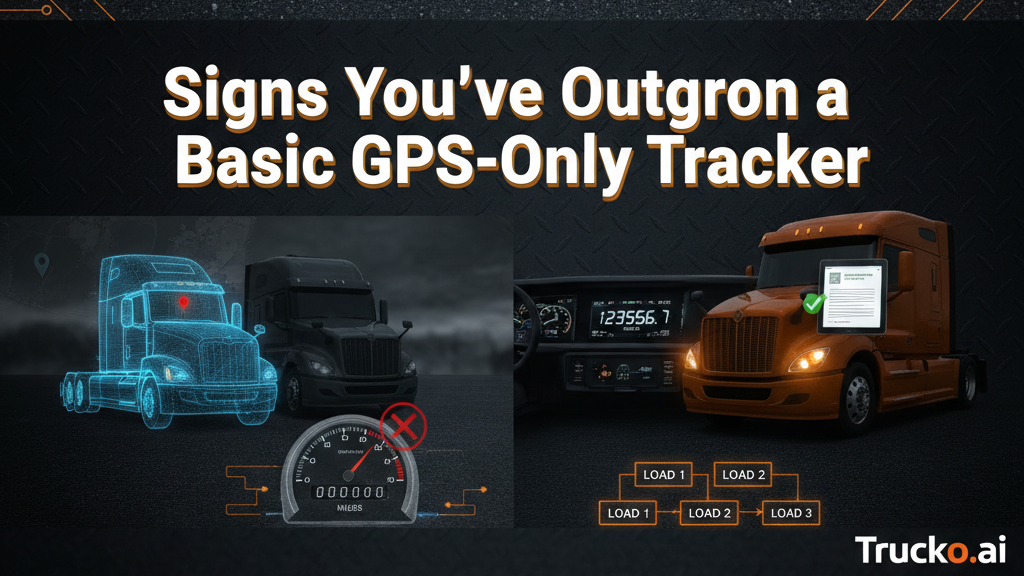
Signs You've Outgrown a Basic GPS-Only Tracker
A GPS tracker does one thing well: it tells you where the truck is right now. When you had two trucks and drove one yourself, that was probably enough. You knew the routes, you handled the paperwork, and if something looked off you could walk over and ask.
At some point that changes. The fleet grows. You're not driving anymore. The disputes start coming from directions you didn't expect. And the tracker that used to feel like control starts feeling like a map with no legend.
This post is about recognizing that inflection point before it costs you.
---
You Know Where the Truck Is, But Not What It Did
This is the most common sign, and most operators don't frame it this way until they're already in a dispute.
GPS tells you the truck was at a location at a given time. It doesn't tell you whether the driver recorded the correct odometer reading, whether the POD was collected, whether the load was actually delivered to the right contact, or whether the fuel card swipe at that stop was legitimate.
Those gaps are where money disappears. Not in dramatic ways, usually. A few miles padded here. A fuel fill that doesn't match the route. A delivery marked complete with no document to back it up. A load that overlapped with the tail end of the previous one.
A GPS ping timestamps a location. It doesn't verify a transaction, capture a document, or gate the next step in a workflow. Those are different tools solving different problems, and conflating them is expensive.
If you've ever looked at your tracker data after a dispute and thought "the truck was there, but I still can't prove what happened," that's the gap.
---
Your Mileage Disputes Have No Neutral Ground
Driver says 340 miles. You think it was 290. The GPS history shows a route, but routes aren't odometer readings, and your payroll formula uses actual miles driven, not estimated distance.
With a GPS-only setup, the conversation goes in circles. You pull up the map. The driver says traffic added miles. You have no start reading, no end reading, no timestamped capture that either party submitted at the time of the trip. You're both arguing from memory and inference.
According to a Chrome River study cited by Automotive Fleet, 76% of documented mileage-fraud cases trace directly to manual submission processes. That's not a driver-character problem. It's a process problem. When there's no enforced capture at the moment it matters, the number becomes negotiable after the fact.
The fix isn't catching drivers lying. The fix is building a workflow where the reading is captured before the truck moves, not reported after the paycheck is cut. GPS can show you the route. It can't replace a timestamped odometer photo taken at load start.
For more on why that capture moment matters, see Odometer Capture: Why Start/End Meter Readings Matter More Than GPS Pings.
---
You're Resolving POD Issues by Phone Call
A driver completes a delivery. The customer calls two days later saying they never got a signed BOL. You call the driver. The driver says they left a copy at the dock. The dock says they don't have it. Now you're in the middle of a he-said/they-said with no document and a payment at risk.
A GPS tracker cannot fix this. It can confirm the truck was at the delivery address. It cannot confirm that the correct document was collected, that the right person signed it, or that the image is legible and stored somewhere your billing team can find it.
POD verification software closes the loop at the delivery event itself, not after the fact. The driver submits the document through the workflow before the load is marked complete. That's not tracking. That's enforcement.
If you're still resolving POD gaps by phone, that's a workflow problem dressed up as a communication problem. See POD & BOL Verification Software: What It Is and Why Manual Uploads Fail for a full breakdown.
---
Fuel Costs Are Climbing and You Can't Explain Why
Fuel is often the second-largest line item after driver pay for a small fleet, and it's also one of the most vulnerable to quiet, incremental fraud.
The NAFA Fleet Management Association has documented that fuel-related fraud drains a meaningful share of fuel spend for fleets that rely on manual or self-reported tracking. That's not because small-fleet operators are careless. It's because the gap between what a GPS tracker sees and what actually happened at the pump is wide enough to drive through.
A tracker shows the truck was near a fuel stop. It doesn't tell you whether the gallons matched the tank size, whether the swipe was on the fleet card or a personal card you'll never see, or whether the stop made sense given the route and the prior fill.
If fuel spend is trending upward without a corresponding increase in loads or miles, and you have no per-load fuel attribution to check it against, you're tracking location but not accountability.
---
Dispatchers Are Still Taking "Where's My Truck" Calls
If your customers and brokers are still calling your dispatcher to ask where their load is, your tracker data isn't reaching the people who need it.
A GPS tracker generates data. Getting that data to a broker or shipper in a format they can act on is a separate problem. If your dispatcher is the bottleneck between the tracker and the customer, you haven't solved visibility. You've just moved the manual step.
The sign that you've outgrown the basic setup isn't that you have no data. It's that the data doesn't flow automatically to where it needs to go without someone in the middle. That dispatcher time has real cost, and it scales badly as the fleet grows.
For the full picture on killing those inbound status calls, see The Dispatcher's Guide to Killing "Where's My Truck" Calls.
---
Load Handoffs Have No Paper Trail
In a small fleet, load handoffs often happen over text. Driver A drops a trailer. Driver B picks it up. Someone forgets to update the board. A load gets missed, or worse, a driver picks up a load without the prior one being properly closed out.
Load overlap is a specific, documented problem: one driver is paid for a load that wasn't fully completed before the next one started. GPS can show you that Truck 7 left the yard at 6 AM and Truck 7 was back at 3 PM the day before, but it can't tell you whether the prior load's documentation was complete before Truck 7 took the new assignment.
Enforcement-gating closes that gap. The next load doesn't open until the prior load's required steps are complete. That's not a GPS function.
Read How to Structure Load Handoffs So Nothing Gets Skipped for a practical look at what that structure actually requires.
---
You're Growing, But Your Dispute Rate Is Growing Faster
This is the clearest signal. When the fleet was small, disputes were rare because the owner was close to every load. As the fleet grows and the owner steps back from day-to-day driving and dispatching, the information gap widens.
More trucks mean more loads, more drivers, more handoffs, more fuel swipes, and more opportunities for the numbers to drift from reality. If your dispute resolution process still relies on calling the driver and pulling up a map, it doesn't scale. Every new truck you add makes the problem proportionally harder.
GPS-only setups were designed for location awareness, not for running a fleet at arm's length. The gap between those two things is exactly what Fleet Accountability Software is built to close.
The distinction matters: a tracker tells you where. Accountability software enforces what, when, and by whom, with documentation attached. For a direct comparison of how those categories differ in practice, GPS Tracking vs. Fleet Accountability Software lays it out side by side.
---
What the Transition Actually Looks Like
Outgrowing a GPS tracker doesn't mean throwing it away. It means recognizing that location data is a starting point, not a complete picture.
The operators who make this transition cleanly usually do it when one of the signs above gets expensive enough to force the question: a mileage dispute that went to mediation, a POD they couldn't produce for a broker audit, a fuel bill they couldn't explain to their accountant.
You don't have to wait for one of those events. The signs are usually visible before the cost is.
---
FAQ
Is a GPS tracker enough for a small fleet of 5-10 trucks? It depends on what you're managing. If you're driving one of the trucks yourself and handling all the paperwork, location data goes a long way. Once you're dispatching drivers you're not riding with and reconciling fuel, mileage, and PODs at the end of the week, location alone starts leaving real gaps.
What's the difference between GPS tracking and fleet accountability software? GPS tracking records where a vehicle was and when. Fleet accountability software enforces what has to happen at each stage of a load: odometer capture, document submission, delivery confirmation. One produces location history; the other produces a verified record of what actually occurred. For a fuller comparison, see GPS Tracking vs. Fleet Accountability Software.
Can I use both a GPS tracker and accountability software at the same time? Yes, and most fleets do. They serve different purposes. The tracker handles real-time location; the accountability layer handles documentation, workflow gating, and dispute resolution. The two don't compete, but the accountability layer is the part that actually resolves disputes.
How do I know if mileage disputes in my fleet are a process problem or a driver problem? If you have no enforced capture of odometer readings at load start and end, it's a process problem first. The Chrome River study cited by Automotive Fleet found that 76% of documented mileage-fraud cases trace to manual submission processes. Fix the process, and the disputes typically drop without any confrontation.
What should I look for in fleet accountability software if I'm coming from a GPS-only setup? Focus on whether it enforces workflow steps rather than just records them. Can a driver skip the odometer photo and still close a load? Can a load be opened before the prior one is completed? If the answer to either is yes, it's still mostly tracking rather than enforcement.
---
Ready to Stop the Guesswork?
Want to know how Trucko handles GPS tracking vs. fleet accountability? see the dashboard and see it for yourself.
For reference, visit trucko.ai.
---
Related Reading
- Fleet Accountability Software
- GPS Tracking vs. Fleet Accountability Software
- Odometer Capture: Why Start/End Meter Readings Matter More Than GPS Pings
- POD & BOL Verification Software: What It Is and Why Manual Uploads Fail
- How to Structure Load Handoffs So Nothing Gets Skipped
- The Dispatcher's Guide to Killing "Where's My Truck" Calls