July 19, 2026 · Trucko Team
POD & BOL Verification Software: What It Is and Why Manual Uploads Fail
POD verification software does more than collect uploads — learn why manual proof of delivery processes create disputes, missing docs, and real dollar losses for small fleets.
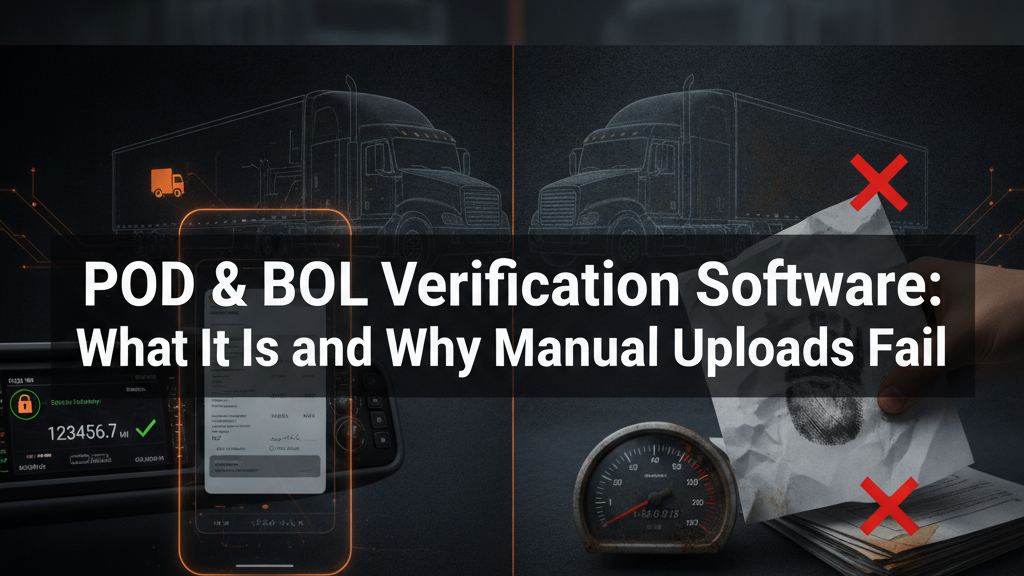
POD & BOL Verification Software: What It Is and Why Manual Uploads Fail
If you've ever chased a driver for a signed BOL three days after delivery, or had a customer dispute a load you know got delivered, you already understand the problem. Proof of delivery is supposed to close the loop. Instead, for most small fleets running manual processes, it opens a new round of phone calls, emails, and arguments.
This guide covers what POD and BOL verification software actually does, why the "we just have them upload a photo" approach keeps failing, and what to look for if you want the process to actually hold.
---
Why POD Goes Missing
The honest answer is that nobody set out to lose proof of delivery documents. It happens because the collection process has too many optional steps and too little accountability.
In a manual workflow, a driver picks up a load, gets a paper BOL signed, and is supposed to photograph and upload it before moving on. Sometimes they do it at the stop. Sometimes they do it that night. Sometimes they forget and upload a blurry photo three days later, or not at all. Nobody flags the gap in real time because there's no system watching for it.
The same pattern plays out at delivery. The driver gets the POD signed, maybe snaps a photo, and drives away. If the image is unreadable, if the signature block is cut off, or if the file never actually uploaded due to a spotty cell signal, you don't find out until a customer calls to dispute the delivery or an invoice gets held.
The root issue is that manual POD collection is passive. It depends on the driver remembering to do it, doing it correctly, and having the connectivity to make it work. When any of those three things fail, the document is gone. And in a dispute, no document means no leverage.
For fleets running five to twenty trucks, a handful of missing PODs per month isn't a minor inconvenience. It's receivables at risk, customer relationships under strain, and time your dispatcher doesn't have.
---
What "Verified" Actually Means vs. "Uploaded"
This is where most fleets get burned, and it's worth being precise about.
"Uploaded" means a file exists somewhere. A driver tapped a button and a photo went to a folder. Whether it's the right document, whether it's readable, whether it was captured at the right location and time — none of that is confirmed. You have a file. You don't have proof.
"Verified" means something different. It means the document was captured at the correct step in the workflow, at the correct location, with enough image quality to be usable, and that capture happened before the driver could move to the next action.
The distinction matters because verification is what holds up in a dispute. When a customer says a load never arrived, an upload timestamp from three days later does very little for you. A geo-tagged, timestamped image captured on-site at delivery, tied to a specific load, before the driver marked the job complete — that's a different conversation.
This is also why BOL verification matters as much as POD verification. The BOL is your record of what left the shipper. If it's missing or altered, you have no baseline for what the load was supposed to contain when it arrived. BOL and POD together are the full chain of custody. Gaps in either one leave you exposed.
You can read more about how these pieces connect in Fleet Accountability Software, which covers the broader framework of tying document capture to operational checkpoints rather than treating it as an afterthought.
---
How Enforcement-Based Apps Prevent the Problem at the Source
The key word in that section heading is "enforcement." Most fleet apps treat document capture as a feature. Enforcement-based apps treat it as a gate.
The difference in practice: a feature-based app gives drivers a place to upload documents. If they skip it, nothing stops them. The dispatcher might notice later, or might not. An enforcement-based app requires the document before the driver can proceed. No POD captured at delivery, no ability to mark the load complete. No BOL captured at pickup, no load can be started. The workflow doesn't move forward without the document.
This shifts the burden completely. Instead of the dispatcher chasing documents after the fact, the app enforces collection in the moment. The driver can't forget because forgetting means they can't log the delivery and get paid. The incentive structure does the work.
There's a related benefit that doesn't get enough attention: it removes ambiguity from disputes between drivers and dispatchers. When a driver claims they delivered a load and a customer claims they didn't, a system with enforced capture at the delivery location, with a timestamp and image attached, ends the argument quickly. Both sides are working from the same record. That's not something a photo texted to a group chat can do.
For fleets that also deal with mileage disputes, the enforcement logic works the same way. A system that requires odometer capture at load start and end, plus document capture at pickup and delivery, creates a complete trip record rather than a collection of fragments. The article What Mileage Fraud Actually Costs a Small Trucking Fleet breaks down how incomplete records are exactly where that exposure lives.
---
What to Look For in POD Verification Software
Not all tools marketed as "POD software" actually solve the enforcement problem. Here's what separates the ones that do from the ones that just digitize a broken process.
Mandatory capture steps, not optional uploads. The app should require photo capture at specific load stages before advancing. If a driver can complete a delivery without attaching a POD image, the system won't help you in a dispute.
Location and time context attached to every image. A photo without metadata is just a photo. The system should record where and when each document was captured, tied to the specific load, automatically. This is what makes the document defensible.
Image quality checks before submission. Blurry, dark, or cut-off images are useless in a dispute. A good system either flags low-quality captures immediately or requires a retake before the driver can proceed. Discovering bad images after the fact is the same problem you already have.
BOL capture at pickup, not just POD at delivery. Full chain of custody means both ends. If your software only handles the delivery side, you're missing half the record. A shipper claiming a load was short or damaged, and your only documentation is a delivery photo, leaves you in a weak position.
Load-level document organization. Documents should be attached to specific loads automatically, not sitting in a generic photo library that someone has to sort manually. When you need to pull the paperwork for a specific delivery on a specific date, it should take seconds, not a search.
Driver workflow that doesn't slow them down. Drivers will work around a system that's clunky. The capture process needs to be fast enough that it doesn't create friction at the dock. A two-tap photo flow that the driver can do while the customer is signing is sustainable. A six-step upload process is not.
For a structured look at how load handoffs should flow from start to finish, How to Structure Load Handoffs So Nothing Gets Skipped covers the full sequence, including where document capture fits within the broader handoff process.
One thing worth being direct about: if you're evaluating tools and you see "AI-powered POD verification" in the marketing, ask specifically what the AI does. If the answer is something vague about smart uploads or automatic sorting, that's marketing language. AI is useful in this context for specific things like image quality analysis or character recognition on document fields. If the vendor can't tell you exactly what the AI is doing, treat it as a checkbox feature.
Also worth noting: Trucko is not a GPS tracker. Its document enforcement works by gating workflow steps, not by monitoring location. The distinction matters because a GPS tracker can tell you where a driver was. An enforcement-based system can tell you what happened there, with documentation attached.
---
FAQ
What is POD verification software used for in trucking? It captures and confirms proof of delivery documents at each load's delivery point, ensuring drivers collect and submit valid documentation before completing a job. The goal is to create a timestamped, load-specific record that holds up in billing disputes and customer claims.
Why isn't having drivers text or email photos good enough? Texted or emailed photos have no load context, no enforced timing, and no guarantee the driver was actually at the delivery site when the photo was taken. In a dispute, you need documentation tied to a specific load, at a specific time and place, that was captured as part of the workflow, not attached to a chat thread.
What's the difference between BOL verification and POD verification? A BOL (bill of lading) is the document created at pickup confirming what was loaded and its condition. A POD (proof of delivery) confirms what was delivered and who signed for it. You need both to establish a clean chain of custody. BOL gaps leave you exposed on the shipper side; POD gaps leave you exposed on the receiver side.
Can POD software help with invoice disputes? Yes. When an invoice is disputed and you can pull a timestamped, geo-tagged POD image tied directly to that load within seconds, the dispute either resolves quickly or becomes a much shorter conversation. Missing or low-quality PODs are one of the most common reasons invoices get delayed or partially rejected.
Does this work for small fleets or is it enterprise-only? Enforcement-based POD verification is actually more impactful for small fleets than large ones, because small fleets don't have a dedicated back-office team chasing documents. The system has to do that work automatically, and it's built to do exactly that without requiring headcount you don't have.
---
Ready to Stop the Guesswork?
Want to know how Trucko handles POD and BOL verification? see the feature in action and see it for yourself.
For reference, visit trucko.ai.
Related Reading
- Fleet Accountability Software
- How to Structure Load Handoffs So Nothing Gets Skipped
- What Mileage Fraud Actually Costs a Small Trucking Fleet
---