July 18, 2026 · Trucko Team
GPS Tracking vs. Fleet Accountability Software: What's the Real Difference
GPS tracking tells you where your trucks are. Fleet accountability software tells you what actually happened on every load. Here's why that gap costs small fleets real money.
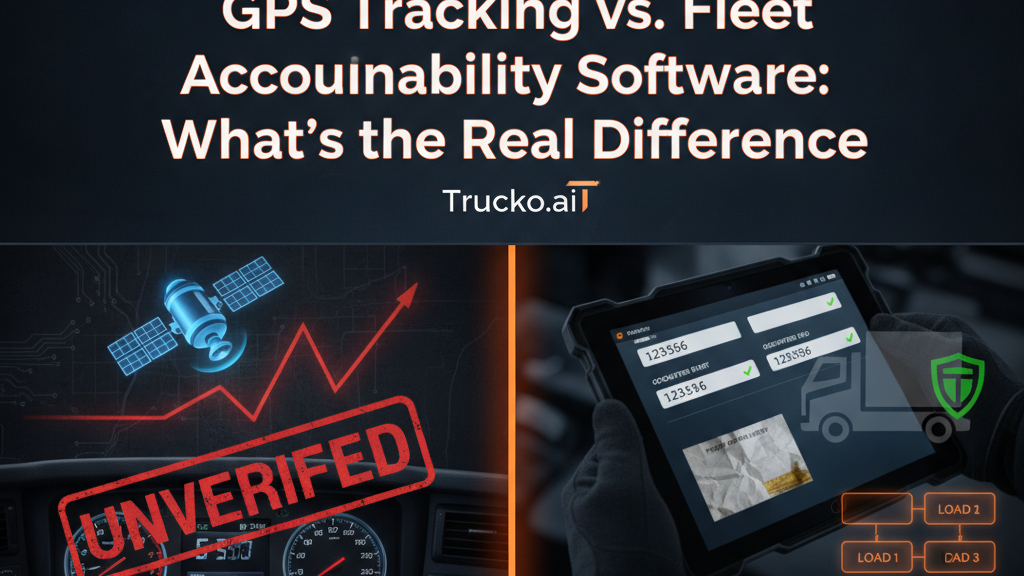
GPS Tracking vs. Fleet Accountability Software: What's the Real Difference
Every fleet manager running five trucks or fifty has been sold the same pitch: put a GPS device on your trucks and you'll know what's going on. And to a point, that's true. You'll know where your trucks are right now. You'll see if one's been sitting at a fuel stop for two hours.
What you won't know is whether the mileage your driver reported matches what actually happened. You won't know if a load handoff was completed or just assumed. You won't know who signed for that delivery, or whether the odometer reading your driver texted in was accurate, or if someone picked up a load they were never assigned to.
That's the gap. And for a fleet running 5 to 50 trucks, that gap is where margin disappears.
What GPS Tracking Actually Tells You (and Doesn't)
GPS tracking does one thing well: it puts a dot on a map and moves it in real time. For visibility into whether a truck is moving or parked, that's genuinely useful. For route playback after the fact, it has value. For giving customers a general sense of where a shipment is, it works.
But GPS tracking is a passive system. It records movement. It doesn't enforce anything, require anything, or verify anything beyond position and speed. The moment you need to answer a question like "did the driver actually start at the mileage they claimed?" or "who confirmed this load was picked up?" a GPS device has nothing for you.
That's not a knock on GPS. It's a category limitation. The problem is that most small fleet operators are sold GPS as if it solves accountability problems, when what it actually solves is visibility problems. Those are related but not the same thing.
The Gap: Knowing Where vs. Knowing What Happened
Here's a common scenario: a driver completes a run, submits mileage, and the number doesn't look right. You pull up GPS history. You can see the route. You can see the truck moved from point A to point B. But your GPS system doesn't capture odometer readings, so you're now comparing a reported mileage figure against a calculated map distance that may or may not account for detours, traffic, or stop sequences.
You have a location record. You do not have a verified trip record.
That's the gap between GPS tracking and fleet accountability software. GPS tracks the truck. Accountability software tracks what happened with the load: who accepted it, what the odometer read at start and end, what documents were captured, and whether any step in the workflow was skipped.
Chrome River research (via Automotive Fleet) found that 76% of documented mileage fraud cases trace directly to manual submission processes. That number exists precisely because GPS tracking is common and manual reporting sits alongside it unchecked. Knowing where the truck went doesn't automatically verify what the driver said about it.
For a deeper look at how this plays out operationally, Fleet Accountability Software covers the full framework.
Five Things a Location Dot Can't Tell You
1. Whether reported mileage matches actual odometer readings. GPS calculates distance based on coordinates. Odometers measure wheel rotations. They produce different numbers, especially on routes with stops, lot movements, or detours. Only captured start and end odometer readings close that gap. GPS doesn't capture them.
2. Whether the right driver picked up the load. Deceptive pickup fraud is rising. According to Verisk CargoNet's Q1 2026 data, impersonation and fraudulent pickup incidents are up 31-35% year over year, even as total incident counts are down. A GPS tracker shows a truck at the pickup location. It doesn't verify that the driver who showed up was the one assigned to the load.
3. Whether a proof of delivery was actually captured. A truck arriving at a delivery address shows up on GPS. A driver signing and uploading a POD does not. Without enforced document capture, you're trusting that paperwork happened because the truck was there.
4. Whether a load handoff was completed or skipped. On multi-leg loads, GPS shows position at each stop. It doesn't tell you whether the handoff checklist was completed, whether the driver acknowledged load condition, or whether the customer actually confirmed receipt.
5. Whether the driver is running loads out of sequence. If a driver accepts a second load before completing the first, GPS shows two locations over time. It won't flag the overlap or prevent it from happening. Sequential load lockout, which blocks a driver from accepting a new assignment until the current one is closed out, is an enforcement mechanism. GPS has no enforcement layer.
When You've Outgrown Basic GPS
There's a natural progression in how fleet operators use technology. Early on, GPS alone is a real improvement over nothing. You can answer the basic "where is the truck" question. You can defend against the most obvious disputes with route history.
But fleets hit a ceiling with GPS-only setups, usually around the same time a few things happen at once: mileage disputes become frequent enough to eat dispatcher time, a payment disagreement with a driver goes unresolved because there's no verified record, or a customer calls asking about a delivery that GPS shows as completed but no POD exists.
At that point, you're not missing a bigger GPS system. You're missing a different category of tool entirely.
GPS trackers from Samsara, Motive, Geotab, GPS Insight, and similar providers are built for visibility and compliance. They are good at what they do. But visibility and compliance are not the same as enforcement and verification. A fleet running manual spreadsheets alongside any of those systems still has an enforcement gap, because the GPS data doesn't validate what gets entered into the spreadsheet.
If you want to dig into the specific signs that basic GPS has stopped being enough, Signs You've Outgrown a Basic GPS-Only Tracker walks through the exact inflection points.
Comparison Table: Trucko vs. Basic GPS vs. Manual Spreadsheets
| Capability | Manual Spreadsheets | Basic GPS Tracker | Trucko | |---|---|---|---| | Real-time truck location | No | Yes | Via driver app check-ins | | Odometer capture (start/end) | Manual entry, unverified | No | Enforced at load open/close | | Mileage dispute resolution | No record | Route playback only | Verified odometer + trip record | | POD/BOL document capture | Email or paper | No | Required step in load workflow | | Load assignment enforcement | Phone/text | No | Sequential lockout enforced | | Driver handoff confirmation | Trust-based | No | In-app acknowledgment required | | Audit trail per load | No | Partial (location only) | Full, timestamped record | | Fraud surface area | High (manual, self-reported) | Medium (GPS + manual) | Low (gated workflow) |
The column that matters most for a small fleet isn't real-time location. It's audit trail per load. When a driver disputes a mileage figure or a customer questions a delivery, a timestamped, driver-confirmed record is what settles it. Route playback is circumstantial. A verified odometer reading is not.
For a direct side-by-side on how this plays out against a specific GPS-based platform, Trucko.ai vs. Samsara: Which One Is Actually Built for a 5-50 Truck Fleet gets into the specifics.
How Accountability Software Works Where GPS Leaves Off
Fleet accountability software doesn't replace GPS for every use case. If your primary need is real-time location for customer-facing tracking links or DOT compliance data, a GPS-based platform addresses that directly. Trucko is not a GPS tracker, and it doesn't position itself as one.
What accountability software does is enforce the workflow around each load. A driver can't close out a load without uploading a POD. They can't open a new load until the current one is completed and confirmed. Odometer readings are captured at the moment of load start and load end, not self-reported later from memory or a notepad.
The mechanism is gating, not tracking. The driver goes through a structured sequence for every load, and the system won't let them skip steps. The result is a verified trip record that exists independently of what anyone says happened after the fact.
For manual fleets, this matters because the Chrome River data point above isn't describing malicious actors exclusively. A lot of mileage discrepancies come from drivers who genuinely misremember, round up, or fill in numbers they think are close enough. Manual submission processes create the conditions for error and fraud simultaneously. Enforced capture removes the conditions for both.
Fuel-related fraud follows a similar pattern. The NAFA Fleet Management Association has documented that fuel-related fraud drains a meaningful share of fuel spend for fleets relying on manual or self-reported processes. The mechanism is the same: self-reported inputs with no enforcement layer are easy to game, even unintentionally.
FAQ
Is GPS tracking the same as fleet accountability software? No. GPS tracking records location and movement. Fleet accountability software enforces the workflow around each load, capturing odometer readings, requiring document uploads, and creating a verified trip record that GPS alone doesn't produce.
Can I use both GPS tracking and fleet accountability software together? Yes, and many fleets do. GPS handles real-time visibility and compliance data. Accountability software handles load verification, mileage confirmation, and dispute resolution. They solve different problems and don't overlap much in practice.
Why does mileage fraud happen even in fleets that already use GPS? Because GPS calculates distance from coordinates, not odometer readings, and because most GPS systems don't enforce what drivers enter manually. Chrome River research found that 76% of documented mileage fraud cases trace to manual submission processes. GPS tracking doesn't eliminate manual submission; accountability software does.
What's sequential load lockout and why does it matter? Sequential load lockout prevents a driver from accepting or opening a new load assignment until the current load is properly closed out, with all required steps completed. It stops load overlap, protects your verified trip records, and removes the ambiguity that makes disputes possible.
Is Trucko a GPS tracker? No. Trucko is fleet accountability software. Its mechanism is workflow enforcement and gating, not location tracking. It produces verified trip records through structured driver workflows rather than tracking a truck's physical position.
Ready to Stop the Guesswork?
Want to know how Trucko handles GPS tracking vs. fleet accountability? see the dashboard and see it for yourself.
For reference, visit trucko.ai