July 15, 2026 · Trucko Team
What Is Fleet Accountability Software? (And Why GPS Tracking Alone Isn't Enough)
Fleet accountability software enforces trip documentation, load sequencing, and proof of delivery at every step — here's what it does that GPS tracking can't.
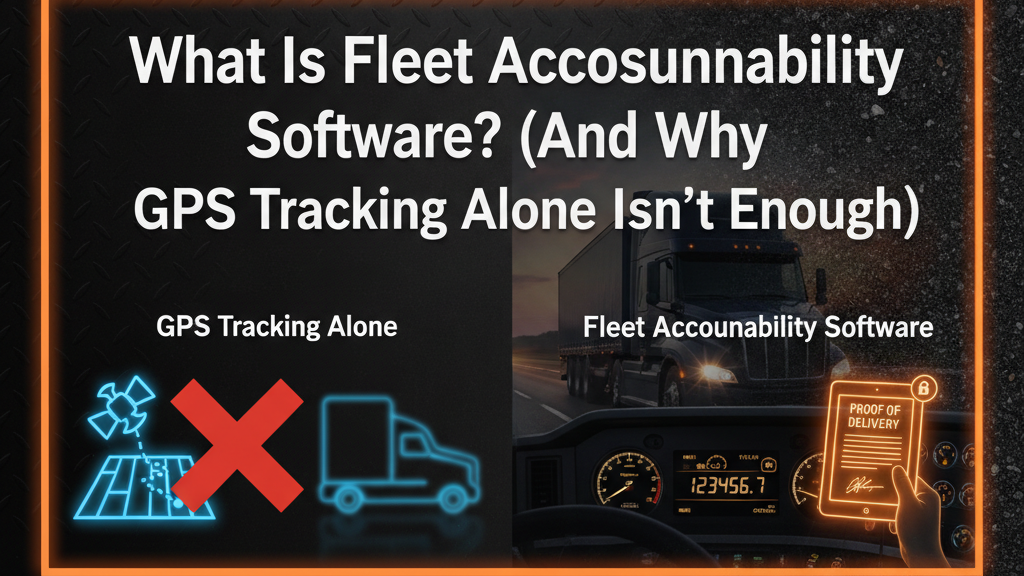
What Is Fleet Accountability Software? (And Why GPS Tracking Alone Isn't Enough)
You can watch a truck move across a map all day long and still not know whether the driver started the trip with the right odometer reading, whether the load handoff was documented, or whether the customer actually received what you sent. Visibility tells you where the truck is. It doesn't tell you whether anyone did their job right.
That gap — between knowing where your trucks are and knowing whether your operation is running clean — is exactly what fleet accountability software is built to close.
This guide explains what the category actually means, how it differs from GPS tracking, which five enforcement points matter most, and why smaller fleets (5-50 trucks) have the most to lose when those points go uncontrolled.
---
The Problem With "Visibility" Without Enforcement
The fleet telematics market has spent twenty years selling visibility. Location data, speed alerts, idle time reports, engine diagnostics. All of it is genuinely useful. None of it stops a driver from submitting inflated mileage. None of it confirms that a BOL was signed. None of it proves the load was picked up by the right person.
Visibility is passive. It records what happened. Enforcement is active. It requires proof before the next step can proceed.
Here's a practical example. Your GPS system shows a truck completed a route from Dallas to Houston. The driver submits 280 miles. The GPS log shows 241. Now what? You have a dispute. You have a screenshot. You have a conversation that goes nowhere productive. You might win that argument, you might not, but either way you spent time on it that you didn't budget.
Now imagine the trip couldn't close without the driver entering an odometer photo at start and end. The mileage is captured at the source, before the payroll run, before the invoice, before any disagreement can take root. That's not visibility. That's enforcement.
According to a Chrome River study cited by Automotive Fleet, 76% of documented mileage-fraud cases trace directly to manual submission processes. The problem isn't dishonest drivers across the board. The problem is a system that creates opportunities, and then has no gate to catch them.
Fleet accountability software is the gate.
---
Fleet Accountability Software vs. GPS Tracking: What's the Real Difference
This distinction matters enough to state plainly, because the market conflates the two constantly.
GPS tracking tells you where your assets are and where they've been. A good GPS system gives you breadcrumb trails, geofence alerts, engine data, and historical playback. Tools like Samsara, Motive, and Geotab do this well. That's what they're built for.
Fleet accountability software enforces what happens at each step of a load. It gates progression through a workflow. It requires documentation before a trip can open, requires proof before a load can close, and captures a verifiable record that lives outside any single person's memory or goodwill.
The two categories are not competing for the same job. GPS tracking answers "where." Fleet accountability software answers "did it happen correctly, and can you prove it?"
For a deeper look at how these two categories split apart in practice, GPS Tracking vs. Fleet Accountability Software walks through the specific scenarios where GPS data runs out of answers.
Small and mid-size fleets (5-50 trucks) often assume that buying a GPS system checks the accountability box. It doesn't. What it checks is the visibility box. Accountability requires workflow enforcement, document capture, and dispute prevention built into the process itself, not bolted on after the fact through spreadsheets and phone calls.
---
The Five Enforcement Points Every Fleet Should Control
There are dozens of things that can go wrong across a load lifecycle. But five enforcement points, if controlled properly, prevent the vast majority of the disputes, payment leakage, and documentation failures that cost small fleets real money.
Trip Start/End Meter Capture
Odometer readings at trip start and trip end are the foundation of mileage accountability. Without them, every mileage figure your drivers submit is based on their word, your GPS estimate, or a route planner's guess. None of those are the same number, and none of them are defensible in a payment dispute.
The problem with most current setups is that odometer capture is either skipped entirely or handled through a text message or phone call that no one can verify later. Self-reported mileage without a timestamped photo is not a record. It's a number with a name attached.
When odometer capture is built into the trip workflow as a required step, the reading becomes tamper-evident, timestamped, and tied to the load record. The dispute either never starts or ends immediately when you can produce the photo. Odometer Capture: Why Start/End Meter Readings Matter More Than GPS Pings explains why the photo matters in ways that a GPS ping simply cannot replicate.
Sequential Load Enforcement
Sequential load enforcement means a driver cannot open a new load until the previous one is properly closed. Sounds obvious. In practice, most small fleets don't have this gate anywhere in their process.
What happens without it: a driver takes load B before finishing the documentation on load A. Load A stays open, its costs bleed into load B, mileage gets attributed incorrectly, and someone has to sort it out later by hand. Or no one does, and the error gets baked into your records permanently.
Sequential enforcement is especially important for multi-stop operations and drivers running regional routes where they might touch three or four loads in a day. It's also the enforcement point most likely to surface a driver who is gaming the system by keeping loads open to inflate hours or mileage across runs.
The True Cost of Load Overlap (and How to Prevent It) digs into what overlapping load records actually cost and how enforcement prevents the compounding errors that follow.
Mandatory POD/BOL Upload
Proof of delivery and bill of lading documentation are not optional. Every broker, every shipper, and every factor knows this. And yet, the most common version of POD collection in a 5-20 truck fleet is still a driver taking a blurry photo that lives on their phone until someone asks for it, at which point it may or may not still be there.
Mandatory upload means the document gets captured at the point of delivery, tied to the load record, and stored where your team can retrieve it without calling the driver. It also means you can prove delivery happened, when it happened, and what condition the freight was in at handoff.
Disputes with brokers and shippers about whether delivery occurred are expensive to resolve and often impossible to win without documentation. The only reliable way to prevent them is to make documentation mandatory before the load closes, not optional afterward.
POD & BOL Verification Software: What It Is and Why Manual Uploads Fail covers what good verification looks like and why systems that allow drivers to upload retroactively create the same gaps as no system at all.
Shareable Customer Tracking
The most common customer service problem in trucking is not a late truck. It's a customer who doesn't know whether the truck is late. The calls that follow eat dispatcher time and make the whole operation look less professional than it is.
Shareable tracking links solve this without adding headcount. When a customer can click a link and see their load's location and estimated arrival, they stop calling. The dispatcher stays off the phone. The driver stays focused on driving.
This is an accountability feature, not just a convenience feature, because it creates a documented, shared view of the load's progress. If a customer later claims the delivery was late or the window wasn't met, the tracking record exists. It's not your word against theirs.
Shareable Tracking Links: How to Stop Customers Calling for ETAs explains the mechanics and what to look for in a sharing system that actually holds up operationally.
Full Load Lifecycle Validation
Each of the four enforcement points above handles one stage of a load. Full load lifecycle validation ties them together into a single, verifiable chain from trip start through final delivery. Every required step is completed, in sequence, with documentation at each handoff.
This matters because the gaps between steps are where the problems live. A driver can upload a POD and still have a disputed odometer. A load can be closed with a mileage entry and no delivery photo. Individual checkpoints without a connected workflow still leave holes that disputes can crawl through.
When the whole lifecycle is validated, you have a complete record for every load. That record protects you in broker disputes, driver payment disagreements, insurance claims, and any audit that asks you to reconstruct what happened on a given run. What a Verified Trip Actually Looks Like shows the specific documentation chain a clean trip produces.
---
Who Actually Needs This (5-50 Truck Fleets, Not Enterprise)
Large fleets have compliance departments, dedicated operations managers, and enterprise TMS systems with custom integrations. They have people whose entire job is catching the errors that fall through the cracks.
A 10-truck fleet has a dispatcher, maybe a part-time bookkeeper, and an owner who is also doing sales, driver relations, and customer service. When a load goes sideways, there's no team to reconstruct what happened. There's just a spreadsheet and whoever picks up the phone.
That's the fleet that gets hurt by mileage padding, because no one is systematically cross-checking submissions. That's the fleet that loses broker disputes, because the POD was never uploaded and the driver doesn't remember the delivery details. That's the fleet where a single fraudulent pickup can cause outsized financial damage, because there's no workflow gate requiring identity verification before a load is released.
The Motive Physical Economy Outlook has documented that fraud and theft compromise a meaningful double-digit share of fleet payments industry-wide. For a large carrier, absorbing some of that cost is painful but survivable. For a 10-truck operation, losing a meaningful chunk of revenue on a handful of incidents can threaten the business.
Enterprise software is also sized wrong for smaller fleets. It's priced for volume, requires dedicated implementation time, and assumes an IT infrastructure that most small carriers don't have. Fleet accountability software for the 5-50 truck market should be deployable fast, require minimal training, and pay for itself by eliminating the disputes and documentation failures it was built to prevent.
Fleet Management Software for a 5-15 Truck Operation: What Actually Matters looks at how priorities shift at smaller scale and which features actually move the needle when you're not running 200 trucks.
---
What This Costs You If You Don't Have It
The easiest way to understand what fleet accountability software is worth is to total up what the absence of it costs. Most fleet owners have never done this calculation because the costs don't show up as a single line item. They're distributed across payroll errors, broker chargebacks, lost disputes, dispatcher time, and the occasional catastrophic load loss.
Let's be specific about the categories.
Mileage leakage. When drivers self-report mileage without odometer verification, there is no mechanism to catch inflation. The Chrome River data cited earlier (76% of mileage-fraud cases trace to manual submissions) isn't describing a rare bad actor problem. It's describing what happens when the system has no gate. Across a fleet of even five trucks, small per-trip errors compound into real money over a year.
Disputed deliveries. Brokers routinely withhold payment on loads where POD documentation is missing or insufficient. If your standard process is "driver takes a photo, you ask for it later," your documentation rate is not 100% and your dispute exposure is real. Every dispute you lose because you can't produce paperwork is a load you moved for free.
Dispatcher time. Phone calls about ETAs, arguments about mileage, tracking down missing BOLs, reconstructing what happened on a load from memory: these are not rare edge cases. They're daily overhead in a fleet that runs on manual coordination. Every hour a dispatcher spends on that work is an hour not spent on operations that grow the business.
Load fraud exposure. Deceptive pickup fraud, where a criminal impersonates a carrier or driver to take a load, is becoming a larger threat to smaller operations. According to Verisk CargoNet's Q1 2026 data, the average value of a stolen shipment is approximately $341,000, and deceptive pickup and impersonation fraud is up 31-35% year over year. The loads aren't more vulnerable because fleets are getting sloppier. They're more valuable targets because the enforcement infrastructure at smaller carriers is thin. Workflow gating, identity verification steps, and load lifecycle documentation all raise the cost of a fraudulent pickup attempt.
Driver disputes. How to Stop Drivers Disputing Mileage (Without More Arguments) addresses this directly, but the short version is this: disputes that stem from a documentation gap are almost impossible to resolve cleanly. Disputes where the documentation exists from the moment the trip opened are usually over in minutes. The difference is the system you ran the trip through.
None of these costs require a catastrophic event. They accumulate quietly, trip by trip, across an operation that's running on trust and hope rather than enforcement and records. Fleet accountability software replaces that exposure with a process that doesn't depend on anyone remembering to do the right thing.
---
Explore the Topics
- What Mileage Fraud Actually Costs a Small Trucking Fleet
- Freight Fraud Isn't Slowing Down in 2026 — It's Changing Shape
- GPS Tracking vs. Fleet Accountability Software
- POD & BOL Verification Software: What It Is and Why Manual Uploads Fail
- How to Stop Drivers Disputing Mileage (Without More Arguments)
- Signs You've Outgrown a Basic GPS-Only Tracker
- How to Structure Load Handoffs So Nothing Gets Skipped
- Odometer Capture: Why Start/End Meter Readings Matter More Than GPS Pings
- The Dispatcher's Guide to Killing "Where's My Truck" Calls
- Trucko.ai vs. Samsara: Which One Is Actually Built for a 5-50 Truck Fleet
- What to Do After a Driver Disputes Their Mileage
- Trucko.ai vs. Motive: Enforcement vs. Compliance-and-Safety Focus
- Samsara vs. Motive vs. Trucko: Which One Fits a 10-Truck Fleet
- Shareable Tracking Links: How to Stop Customers Calling for ETAs
- Fleet Management Software for a 5-15 Truck Operation: What Actually Matters
- [[Newsjack: Q2 2026 CargoNet/Highway data release]](https://trucko.ai/blog/q2-2026-cargonet-highway-fraud-data)
- Deceptive Pickup Fraud, Explained for Small Carriers
- GPS Insight vs. Trucko: Tracking Depth vs. Enforcement
- The True Cost of Load Overlap (and How to Prevent It)
- What a Verified Trip Actually Looks Like
---
FAQ
What is fleet accountability software and how does it differ from a GPS tracker? Fleet accountability software enforces documentation and workflow completion at each stage of a load, from trip start through delivery. A GPS tracker records location and movement data. The first prevents disputes and documentation failures by requiring proof. The second tells you where your truck went.
Does my fleet need accountability software if I already have GPS tracking? They serve different purposes, and most fleets that run into mileage disputes, missing PODs, or load documentation problems have GPS tracking already. GPS does not require odometer photos, does not gate the next load until the previous one is closed, and does not enforce POD upload before a trip can close.
What size fleet benefits most from fleet accountability software? Fleets in the 5-50 truck range typically see the most direct benefit because they lack the dedicated compliance staff that larger carriers use to catch documentation gaps manually. The smaller the team managing operations, the more important it is that the software enforces the process rather than relying on someone to follow up.
How does sequential load enforcement prevent fraud? Sequential enforcement requires a driver to fully close one load before opening another. Without it, a driver can hold multiple loads open simultaneously, creating mileage attribution errors and inflated hours that are difficult to unravel after the fact. The gate forces completion of documentation at each step before the next load becomes available.
What documentation should a fleet accountability system capture at minimum? At minimum: a timestamped odometer photo at trip start and trip end, a signed POD or BOL upload before load close, and a sequential load record that ties each document to the specific trip it belongs to. Those four elements cover the majority of dispute scenarios a small fleet will encounter.
---
Ready to Stop the Guesswork?
Want to know how Trucko handles fleet accountability and load lifecycle enforcement? Book a demo and see it for yourself.
For reference, visit trucko.ai.